
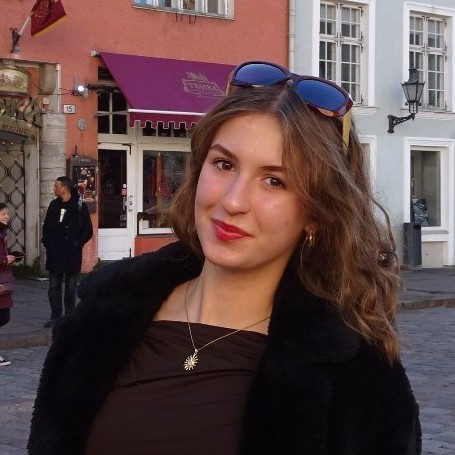
Maja Grzeszczyk
Hi everyone!
I’m Maja, a second-year in the English Chemical Engineering programme. Originally from Poland, though before landing in Otaniemi, I graduated from high school in India. Having moved between different cultures, I know how much community matters in making a new place feel like home. Otaniemi has given me that sense of belonging, but there is so much more to do to make it even more inviting, which is why I’m excited to take on the role of International and Master’s Captain!
You’ve certainly seen me around, organising English-speaking events in PT with the International Committee, which I manage as the CEO (Chem Eng Officer) under the International Captain’s guidance. In that role, I’m also a board member and secretary of the English Bachelors Committee (ETCo), an association connecting English-speaking students across seven guilds, where I represent PT. If I’m not talking to you at an event, I’m probably spinning at salsa (my most recent passion project!) or trying out new baking recipes (emphasis on trying).
Over the past year, I’ve learned a lot about organising events, collaborating across communities, and turning ideas into opportunities for people to connect. I have really enjoyed community-building, whether it be bigger ETCo sitsits or smaller themed hangouts like IntCo’s recent PowerPoint night! I can’t wait to contribute even more energy and passion to the next chapter of PT, which is why I’d love to take on a more active role in shaping PT’s future as a board member.
Through my actions, I strive for inclusivity, meaning that incoming exchange and master’s students should feel welcome and, above all, a crucial part of the student culture. Building on tradition and collaboration with other CHEM captains and KvTMK is the foundation of my vision. Ultimately, I want PT to thrive as a diverse, integrated and inclusive community for all.
How would you make sure that cooperation with the three guilds’ Heads of International and Master’s Affairs works smoothly and effectively?
Open communication, thoughtful planning and mutual support are key to successful teamwork. Since master’s fuksis can attend events of all four CHEM guilds during their first year, I find it imperative that we work closely together to give them a memorable experience.
Practically speaking, I see us meeting regularly every other week, even if briefly, to share updates, track event preparations, divide responsibilities, and develop a shared vision for the year ahead. On a personal level, I want to build a space where every head feels comfortable sharing ideas, asking for help, and trying new approaches. By understanding each other’s perspectives and accommodating different working styles, we can pool our resources and turn even the craziest ideas into reality. I believe that us having a good time working together will contribute to a warm and welcoming atmosphere at our events. When disagreements arise, I address them directly, respectfully, and privately, before misunderstandings grow into bigger issues. At the end of the day, we are all working towards a shared goal of making the fuksi year special.
How would you ensure the equality of Finnish- and English-speaking students in the activities of our guild?
I believe that ensuring equality between Finnish- and English-speaking students at PT starts with understanding what equality means in practice. To me, the biggest challenge currently facing our guild is the language barrier, which affects both Finnish- and English-speaking students in different ways. We cannot expect Finnish-speaking students to communicate in English at all times, as speaking another language can be difficult and uncomfortable for many. At the same time, English-speaking students cannot fully participate in guild activities if these are not conducted in English. The challenge, therefore, is to find a balance that allows both groups to feel equally welcome and included in guild life.
One practical way to address this is by ensuring consistent bilingual communication. PT already does this well in many areas; however, less formal communication, such as Telegram polls or last-minute messages, often takes place only in Finnish. Although these instances may seem minor, they can unintentionally exclude English-speaking students from participating. Implementing small changes can make a big impact.
Beyond communication, I believe that navigating a multicultural and multilingual community requires understanding and awareness. For many Finnish and international students alike, Aalto may be their first experience in such a diverse environment. Officials are among the most active members, contributing immensely to the atmosphere at PT. That’s why I would introduce a workshop on navigating multicultural and multilingual environments for willing officials. It would also create an opportunity to bring Finnish- and English-speaking officials together and better understand each other’s experiences.
Most importantly, I believe that equality through integration should be our guiding principle. Making PT more inclusive does not mean making it less Finnish or diminishing Finnish language and culture within the guild. Rather, it means making the culture and traditions more accessible by creating room for more translation, mutual understanding, and facilitated integration so Finnish- and English-speaking students can participate in the same community instead of being separated into different groups. My goal is to create a guild where we acknowledge and accommodate linguistic and cultural differences, and where everyone has the opportunity to feel they belong to PT.
How could international students and English-speaking bachelor students be encouraged to participate in the activities of the guild? In general, how would you encourage all members to participate in international activities?
This ties closely to my response to the last question about equality. Many might be discouraged from participating due to a language barrier or feel intimidated to go to when they don’t know that many people there. This affects both English- and Finnish-speaking students, as both groups may feel that events held in the other language are not intended for them. I believe the key is to make everyone feel welcome and encourage connections across language groups.
Having even one familiar face at an event can make a big difference, which is why rather than just focusing on increasing event participation, we should focus on designing events based on integration; participation will follow. Creating new connections becomes more difficult after orientation week as people settle into their friend groups, but it doesn’t have to stay that way. A great example was the Fuksi Friendmaker event I organised with Chem Eng Isos, where, through a surprise game, we mixed the fuksis and encouraged them to get to know one another outside of fuksi groups. This created opportunities to make new friends and find familiar faces to turn to around campus, making it easier to participate in student culture for those who might be more shy. Furthermore, I believe we shouldn’t solely focus on fuksis. Organising events that bring together Finnish- and English-speaking officials and ISOs would help build connections among existing members, who could then contribute to a more inclusive guild culture.
Finally, I would encourage participation through low-threshold activities where language is less central, for instance, arts and crafts evenings. The recent collaborations between PT’s international committee and crafts club is a great example of how shared interests can bring people together regardless of their linguistic background.
0 Comments