
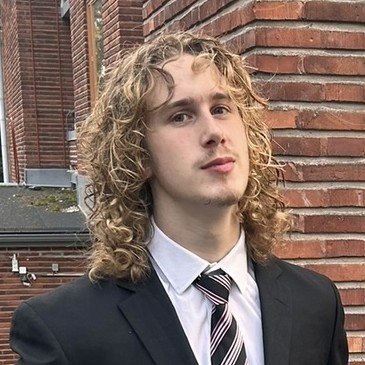
Miles Clover
Moving to Finland was scary. I was leaving behind my close knit circle of friends and family in England to start a new social life from scratch. No one had watched the shows all my references came from, I couldn’t find my favourite sauces anywhere, I called my friends obsessively. There were weeks where I questioned my decision to come here, as I missed having that shared identity with the people around me. Prosessiteekkarit was where I found that identity, and it ended up being where I rebuilt that sense of community that I was missing.
This experience is not just unique to me. Our guild is often the first and most accessible community new arrivals find, which makes the International and Master’s Captain one of the guild’s most consequential roles. I am applying for this position to build on the brilliant work PT has already started.
Being an activity co-ordinator for IntCo has already given me insight into designing events with an international focus, and it’s allowed me to see where the English-side infrastructure is working, and where it isn’t. These past two months as a ChemEng ISO have also allowed me to understand a new arrival’s first weeks from a new perspective, and what makes them stay engaged in guild life. Alongside the guild roles, my junior board role for Entropy has given me work experience of how boards operate, alongside event organisation at a scale the committee itself doesn’t reach, from IntCo’s 12-person murder mystery event to 400-person Entropy raves. And building on the involvement that led to me being named fuksi doctor in my own fuksi year, I am PT’s only exclusively English-speaking songleader apprentice, a visible cultural role that’s required working comfortably in front of both English and Finnish audiences.
The guild’s English side has grown fast enough that the structures around it have more work to do to keep up, and master’s and exchange cohorts fall into a gap between fuksi programming that’s not built for them and general guild life that’s difficult to break into mid-degree. My job in 2027 would therefore be about building on what previous international committees have put in motion into something more durable: bilingual events that integrate the Finnish side, structural support for English-speaking volunteers to take on official roles, and master’s-specific integration that allows them to enter guild life at any time. The goal ultimately is to make more of the guild accessible to more of its members.
On the board, I’d aim to be active both in meetings and in informal settings. My Finnish works for daily life but isn’t yet at the level required for board meetings. I’d lean on preparation and follow-up to carry my weight in the meantime, and expect to be in active language work throughout the year.
A year ago, this guild became home to me because of the people within it; this role is where I’d try to be one of those people for our new arrivals.
– Milo
How would you ensure the equality of Finnish- and English-speaking students in the activities of our guild?
Equality in a bilingual guild is a many-dimensional problem that no single tenure can fully solve. The area that I can most usefully focus on is the gap between the bilingual practices that PT already has (bilingual info messages, event language specification, translation at major events) and where these practices sometimes fall short.
Having been involved on many committees within the guild, I’ve been able to identify many of these gaps between what I like to call ‘functional equality’ and ‘true equality’. Songleaders sometimes slip into Finnish-only during aasinsillat. Event materials are bilingual, but the English version is often less detailed than the Finnish one. Committee chats convey major administrative information in both languages, but informal discussion often reverts back to Finnish, which deprives English speakers of the social benefit being on the committee brings. These aren’t failures of our practices per se, more so they are predictable patterns that come about when they are exercised day-to-day.
It’s important not to forget that equality does work both ways. Finnish speakers are equally at risk of exclusion from international events where the default is English, and it’s worth being deliberate about alongside the more visible reverse direction. IntCo has actually been working on this all year as a priority: we’ve done equal promotion across all channels, and attendance at IntCo events is still almost entirely internationals. The lesson we’ve taken away is that equal promotion doesn’t mean equal attendance, and that the fix isn’t more or better promotion but adjustments to the design of events and invitations.
Which brings me onto what I will push for: bilingual standards embedded in the training of public-facing official roles, ensuring English event information matches the depth of their Finnish counterparts, event design that mixes groups rather than letting them cluster by language, event design that gives Finnish speakers specific reasons to attend international events, and above all ongoing reporting and experimentation to determine what is working and what isn’t.
How could international students and English-speaking bachelor students be encouraged to participate in the activities of the guild? In general, how would you encourage all members to participate in international activities?
What I have found out from being an ISO is that participation doesn’t necessarily improve the more events you add to the calendar. The current English bachelor’s fuksis show early signs of being the most engaged fuksi cohort yet, and I would like to attribute that to two things: engineering scenarios where friendships form and older students who are visibly excited about participating in guild life.
A specific example of the engineering that promotes the formation of relationships is the fuksi friendmaker event that was put on by the ChemEng ISOs thanks to the initiative of CEO Maja Grzeszczyk. We split fuksis up based on responses to a personality test and had them compete in various challenges. This kind of intervention pays off significantly in the long term as it lowers the barrier to entry for future participation in events, as it’s way less daunting if you already know people who are already going. It’s events like these that I will push to make official parts of the PT calendar with additional resources and more time to refine the idea. Alongside this, informal gatherings such as pHuone hangouts, sports afternoons, mini-excursions and pub quizzes (that are recurring, low stakes, and possible to join at any time) are another way to lower guild life’s barrier to entry and serve as a natural environment for friendships to develop.
Having older students that are visibly enthusiastic about PT is admittedly harder to engineer and comes about more naturally through encouraging a positive guild culture. New international students are able to read what engagement looks like from those that are a year or two ahead of them, and tutors will be their first and most prominent channel for this. The ISO team this year has leaned on being present at events the fuksis attend, expressing the parts about the guild and our roles that we genuinely love, and sharing insights into what we get up to behind the scenes. Modelling this sort of behaviour is much better for encouraging participation than explicit motivation. As captain I would be able to set the framing for the following year’s international and master’s tutor team, therefore making me a consequential influence of this factor.
As for the second half of the question, encouraging all students to participate in international events is an issue that is currently unresolved and that IntCo is working hard on as previously discussed. However, the principles that apply to international students also apply similarly to Finnish students. The gatherings I mentioned earlier can be adapted to promote cross-language friendships and to have Finnish-speaking roles that allow Finnish students to be participants rather than audience members. This is harder to engineer as fuksis naturally form friendships within their own language first, which is why this problem relies more heavily on active tutors who are connected across language lines and make the effort to involve all students. The honest acknowledgement is that this is an ongoing problem that I would work on consistently throughout the year.
How would you make sure that cooperation with the three guilds’ Heads of International and Master’s Affairs works smoothly and effectively?
The four of us will be meeting weekly with the rest of KvTMK, so some of the infrastructure for cross-guild collaboration already exists because of that. What we can do on top of that is use those weekly meetings to coordinate CHEM-specific work without the additional burden of an additional commitment. This can be as simple as meeting for coffee or lunch beforehand to update each other on our respective guilds. I also plan on setting up our own dedicated Telegram channel for cooperation between meetings and to handle things that don’t require an in-person discussion. Some events such as orientation week and wappu have much more extensive programming that require further cooperation and commitment, and for those instances we would have dedicated in-person meetings.
PT’s International and Master’s captain oversees both international bachelor’s and PT’s share of the master’s and exchange programming, which makes it a larger role than the other three CHEM guilds. This means that I would have to approach cooperation with the awareness that my own capacity may at times be more stretched than the others. The exact workload split will be built based on open communication between myself and current and future captains.
0 Comments